Key Technical Criteria Defining a Best SWR Pipe Brand
1. IS 13592 Standard Compliance
IS 13592 is the Indian Standard covering unplasticized polyvinyl chloride (uPVC) pipes for soil and waste discharge systems, including associated rainwater applications within its scope. Buyers should verify the applicable standard, product marking, nominal diameter, and conformity documentation before purchasing.- Type A SWR pipes: Generally intended for rainwater and ventilation applications, subject to the standard's requirements.
- Type B SWR pipes: Generally intended for soil and waste discharge applications where the specified wall thickness and performance requirements apply.
2. Precision Push-Fit and Rubber Ring Jointing
A properly designed push-fit joint with a compatible elastomeric rubber sealing ring can provide a reliable seal while accommodating specified movement in the piping system. Its benefits include:- Movement accommodation: Allows for designed thermal expansion and contraction when installed with the correct insertion depth and movement allowance.
- Leak prevention: Helps prevent wastewater from escaping at pipe connections when the seal is correctly fitted and maintained.
- Faster installation: Can simplify assembly compared with joints that require solvent application and curing.
- Serviceability: Supports disassembly and maintenance where the manufacturer's joint design permits it.
3. UV Stabilisation and Chemical Resistance
Drainage pipes installed on exposed terraces, external walls, or other sunlit locations may experience ultraviolet radiation and temperature fluctuations. When outdoor installation is required, check the manufacturer's documentation for UV resistance and suitability for the intended exposure. uPVC offers useful resistance to many substances encountered in domestic drainage, including common cleaning agents, but chemical compatibility depends on concentration, temperature, exposure duration, and the specific formulation.4. Smooth Internal Bore and Hydraulic Performance
A smooth internal pipe surface helps wastewater flow efficiently and reduces the tendency for deposits to accumulate compared with rough or deteriorated surfaces. Look for:- Consistent internal dimensions: Support predictable flow and appropriate system design.
- Compatible fittings: Help minimise abrupt changes in direction and unnecessary flow restrictions.
- Correct gradients: Encourage effective gravity drainage and reduce standing wastewater.
- Accessible cleanouts: Make routine inspection and blockage removal easier.
IS 13592 Type A vs. Type B SWR Pipes: Technical Comparison
The following table outlines the general application differences. Exact dimensions, wall thicknesses, and permissible joint configurations must be verified against the applicable edition of IS 13592 and the manufacturer's product catalogue.| Parameter | Type A SWR Pipes | Type B SWR Pipes |
| Primary application | Rainwater and ventilation applications within the standard's scope | Soil and waste discharge applications within the standard's scope |
| Wall thickness profile | Type-specific minimum wall thickness prescribed by the applicable standard | Type-specific minimum wall thickness prescribed by the applicable standard |
| Impact and structural resistance | Must meet the applicable requirements for its classification and intended installation | Must meet the applicable requirements for its classification and intended installation |
| Push-fit jointing | Use a compatible rubber ring system where specified by the manufacturer | Use a compatible rubber ring system where specified by the manufacturer |
| Solvent-weld jointing | Only where permitted by the product specification and applicable requirements | Only where permitted by the product specification and applicable requirements |
| Common nominal diameters | 75 mm, 110 mm and 160 mm, subject to product availability | 75 mm, 110 mm and 160 mm, subject to product availability |
Complete Leak-Proof Ecosystem: SWR Traps and Special Door Fittings
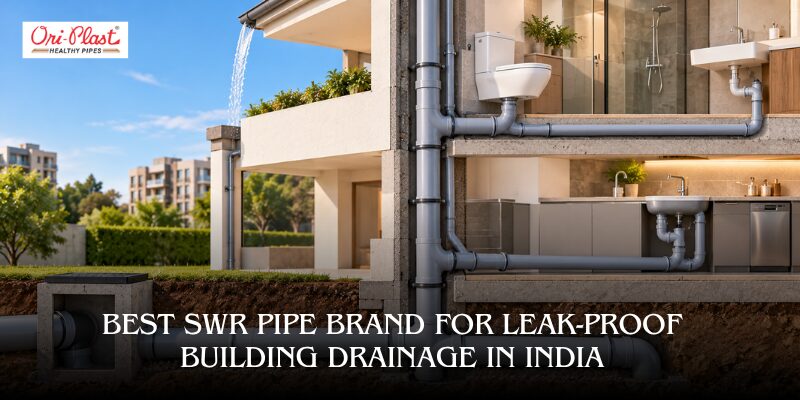
A dependable drainage network requires more than good-quality pipes. Traps, inspection fittings, bends, and ventilation components work together to control odours, maintain drainage flow, and simplify maintenance.1. P-Traps, Q-Traps, and S-Traps
Traps are designed to retain water and create a barrier against foul sewer gases entering occupied spaces. The appropriate configuration depends on the plumbing fixture, outlet arrangement, and drainage layout.- P-Traps: Commonly used with fixtures connected to horizontal waste outlets.
- S-Traps: Used in suitable configurations where the outlet connects downward, subject to applicable plumbing requirements.
- Q-Traps: Used in compatible drainage arrangements where the outlet geometry requires this configuration.
2. Door Tees and Door Bends
Inspection fittings provide access to drainage lines for cleaning, maintenance, and blockage removal without dismantling extensive pipe sections.- Door Tees: Provide access to suitable junctions in the drainage network.
- Door Bends: Allow inspection and cleaning at selected changes in pipe direction.
- Sealed access caps: Help prevent wastewater leakage and odour escape when correctly installed and secured.
3. Vent Cowls
Vent cowls are used at suitable ventilation pipe terminations to help protect the opening from debris and environmental exposure while allowing the designed ventilation arrangement to function. Proper ventilation helps manage pressure fluctuations in drainage stacks and supports the maintenance of trap water seals. Their selection and placement should follow the drainage design and applicable installation requirements.Why uPVC SWR Pipes Can Be a Practical Alternative to Cast Iron Drainage Lines
For residential towers, commercial buildings, hospitals, and hotels, material selection affects installation time, structural loading, maintenance, and long-term operating costs.1. Lightweight Construction and Installation Efficiency
uPVC pipes are generally lighter than cast iron pipes of comparable drainage applications.- Reduced handling effort: Lightweight sections can be easier to transport and position.
- Installation efficiency: Compatible push-fit systems can simplify assembly and reduce dependence on jointing processes that require curing.
- Lower dead load: The pipework itself generally contributes less structural weight, although the complete system load must include wastewater, fittings, supports, and other components.
2. Corrosion and Rust Resistance
Unlike cast iron, uPVC does not rust. Its resistance to corrosion makes it suitable for many domestic soil and waste drainage applications. Potential advantages include:- No routine rust-prevention painting for the pipe material itself.
- No conventional anti-corrosive coating required for uPVC surfaces.
- Resistance to many substances found in domestic wastewater.
- Reduced exposure to corrosion-related deterioration under suitable operating conditions.
3. Lifecycle Value and Maintenance
A drainage system's lifecycle cost includes the initial purchase price, installation, inspection, cleaning, repairs, and eventual replacement. A correctly designed uPVC system can offer practical lifecycle benefits through corrosion resistance, lightweight construction, and accessible maintenance points. Claims of a 50-year or longer service life should be supported by product-specific evidence and should not be treated as a universal guarantee for every installation. To maximise service life, use compatible fittings, provide adequate supports, follow the prescribed installation procedure, and avoid operating conditions outside the product's rated limits.Why Choose Ori-Plast SWR Pipes & Fittings?
Ori-Plast Limited is an established Indian polymer products manufacturer with a history dating back to 1965. Its SWR Pipes & Fittings range is relevant to buyers seeking drainage solutions for residential and commercial construction. The following considerations can help project teams evaluate Ori-Plast for their drainage requirements.1. Established Manufacturing Experience
Ori-Plast's manufacturing history provides a foundation for evaluating its experience in polymer piping. Builders and consultants should review the company's current product documentation, applicable certifications, and quality assurance information when preparing project specifications.2. Jointing Options for Drainage Applications
The jointing system is a key factor in leak prevention. Where compatible rubber ring push-fit products are specified, correct seal placement, insertion depth, pipe alignment, and support are essential to reliable performance. Confirm the jointing options available for the specific Ori-Plast SWR pipe series and diameter before finalising the bill of quantities.3. Compatible Pipes, Fittings, and Accessories
A coordinated product range can simplify procurement and installation by helping ensure that the required fittings match the selected pipe dimensions and connection system. Depending on product availability, project teams should identify the necessary bends, tees, traps, inspection fittings, reducers, and ventilation accessories before installation begins.4. Suitability Across Building Types
SWR drainage systems are used in a wide variety of buildings, including:- Residential projects: Apartments, individual houses, and multi-storey residential developments.
- Commercial properties: Offices, retail buildings, and business complexes.
- Institutional buildings: Hospitals, educational facilities, and hotels, subject to project-specific drainage requirements.