
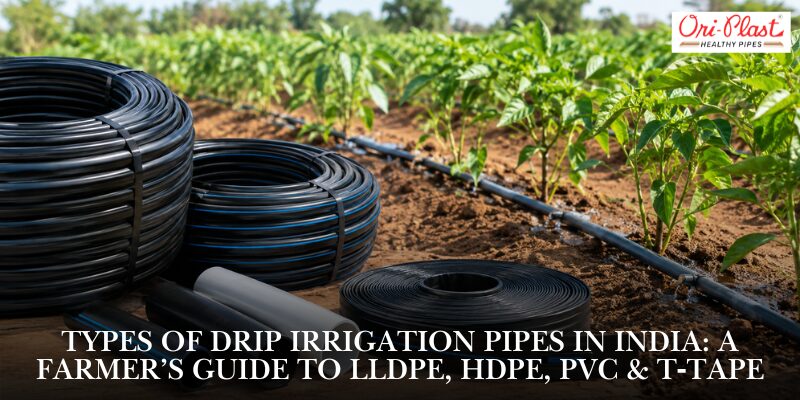
A farmer stared at wilting tomato rows in Raipur, heart sinking. The borewell was running, the pump humming, yet half the field stayed dry. The old flood method had eaten up diesel and time, and the cheap "drip" bought last season cracked under the sun. This situation is common across India, where farmers lose 30–70% of water to evaporation and runoff with traditional methods, while well-designed drip systems can push water-use efficiency to 85–95%.
The real problem often comes down to choosing the wrong pipe for the wrong job. This guide walks through the types of drip irrigation pipes and fittings for farms in India—LLDPE, HDPE, PVC, and T‑Tape—so the right material can be matched to its purpose, costly mistakes avoided, and every drop delivered to the roots that need it.
When asking, "what are the types of drip irrigation pipes in India," the answer breaks into four main families, each with a clear role in a drip system.
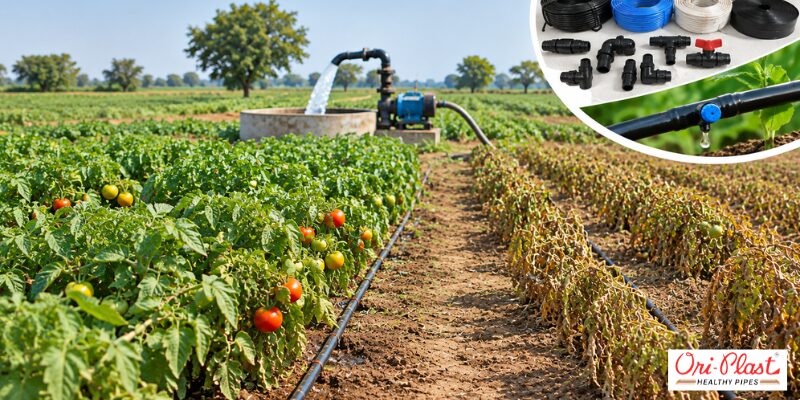
LLDPE Lateral Pipes: The Workhorse of Drip Lines
What is LLDPE drip irrigation pipe? It's a flexible, UV-stabilized polyethylene tube—usually 12mm, 16mm, or 20mm—used as the lateral line that runs along crop rows. LLDPE offers better tensile strength and abrasion resistance than standard LDPE, making it ideal for inline drippers and punch-in emitters. Many growers in Punjab and Jaipur prefer 16mm LLDPE laterals with 30–40 cm dripper spacing for vegetables and orchards because they balance flow, durability, and cost.
HDPE Main & Submain Pipes: From Borewell to Field
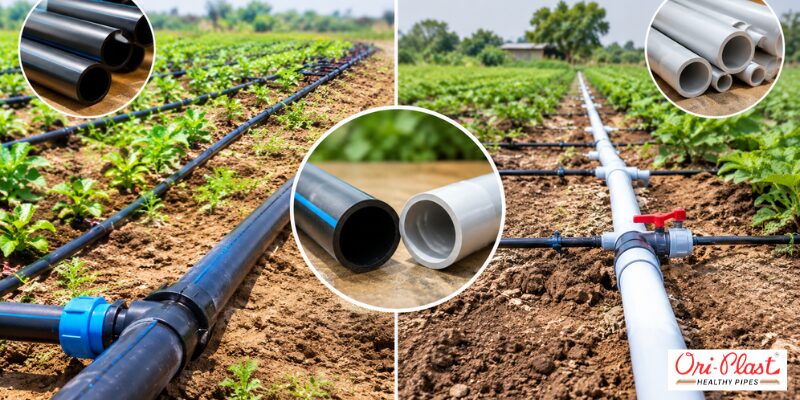
What is HDPE pipe used for in drip irrigation? HDPE (High-Density Polyethylene) handles higher pressures and longer runs, so it's commonly used as the main line carrying water from the borewell or pump house to the field, and as submains feeding laterals. If searching for "HDPE pipe for borewell to field India," sizes like 50mm, 63mm, or 75mm come up, chosen by flow rate and distance. HDPE's flexibility helps on uneven terrain, and its pressure rating makes it suitable for buried installations where rodents or sunlight won't degrade it quickly—the same reasoning behind Oriplast's HDPE and MDPE pipes for agricultural water supply.
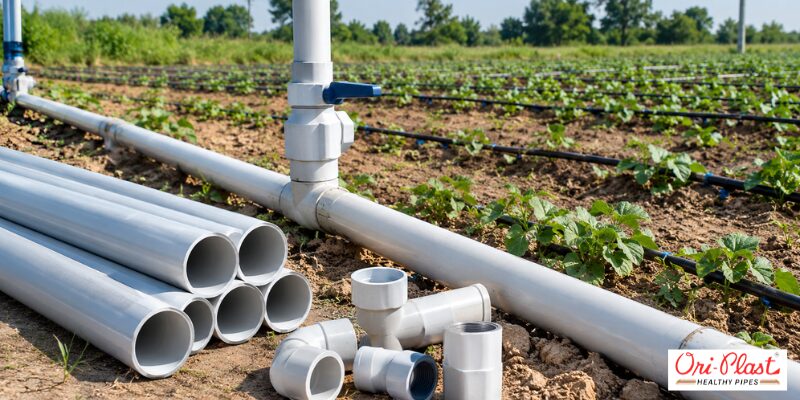
PVC Pipes & Fittings: Rigid Lines for Main Networks
What is PVC pipe used for in drip systems? PVC (including uPVC and cPVC) is rigid, cost-effective, and widely used for main lines, manifolds, and fixed networks in agriculture. When comparing "PVC vs HDPE for main line in drip irrigation," PVC often wins on upfront cost and ease of gluing fittings, while HDPE may be preferred for long, buried runs or where ground movement is expected. Many irrigation designers in Odisha and Guwahati specify uPVC pipes for surface-laid agricultural mains for surface-laid systems with clear access for maintenance.
T‑Tape (Drip Tape): Thin, Flat, and Seasonal
T‑Tape is a thin-walled, flat polyethylene tube that inflates with water pressure and delivers uniform flow through integrated emitters. It's popular for seasonal vegetables, raised beds, and tight budgets. In a direct "T‑tape vs inline lateral" choice, tape is lighter and cheaper per acre but typically replaced every 1–3 seasons, while round LLDPE laterals last longer in perennial crops.
How to Choose the Right Pipe for Your Farm
Asking "how to choose drip irrigation pipe for a farm" really means matching three things: crop type, field layout, and budget.
Match Pipe to Crop & Layout
Vegetables (tomato, chilli, cucumber): 16mm LLDPE inline laterals with 30 cm spacing or 16mm T‑tape for short-season crops.
Orchards & vineyards (mango, pomegranate, grapes): 16–20mm LLDPE laterals with 40–60 cm spacing, fed by HDPE and PVC submains built for agricultural irrigation networks.
Long runs from borewell: HDPE main line sized by flow and pressure; PVC manifold near the field for easy valve control, drawing on the same borewell and column pipe range used for tube wells.
A grower in Assam raising pineapple on sloping land might choose HDPE mains for pressure stability and LLDPE laterals with pressure-compensating drippers to keep flow uniform across rows.
Check Standards & Certifications
Look for ISI certified drip irrigation pipe India markings and UV-stabilized grades. Quality pipes carry clear size, pressure rating, and material info. Cheap, unbranded lines often fail within a season, costing more in replacements and lost yield—the same counterfeiting risk covered in how to spot a genuine ISI mark on PVC pipes. Many state subsidy schemes under PMKSY require approved brands and specifications, so certification isn't just about quality—it's about eligibility.
Size It Right: Diameter, Thickness, Spacing
Diameter: 12mm for short laterals; 16mm is the standard for most row crops; 20mm for long laterals or high flow.
Wall thickness: 0.6mm for light-duty seasonal use; 0.8–1.0mm for multi-season orchards and rough handling.
Dripper spacing: 30 cm for dense vegetables; 40–60 cm for wider-spaced fruits and vines.
Government data shows over 110 lakh hectares now under micro-irrigation in India, with small farmers getting up to 55% central assistance (plus state top-ups) under Per Drop More Crop—so sizing correctly helps claim subsidy without rework.
PVC vs HDPE Main Line for Drip Irrigation: Which Wins?
The query "PVC vs HDPE main line for drip irrigation" is common because both materials dominate main-line designs.
PVC advantages: Lower initial cost, rigid shape for neat surface layouts, easy solvent-weld joints, wide availability of fittings.
HDPE advantages: Better impact resistance, flexibility for undulating fields, suitable for buried lines, handles pressure surges well.
In practice, many systems use a hybrid: HDPE from borewell to field boundary, then PVC manifolds and valve boxes near the plot, following the same agricultural piping solutions used across Indian farms. A dealer in Kolkata might recommend HDPE for long underground runs to avoid joint leaks, while a designer in Jaipur could specify PVC for surface mains where quick modifications are expected.
Common Problems in Drip Irrigation Pipes in India
Even good systems fail if pipes are misused. Here are the common problems in drip irrigation pipes India growers report, and how to avoid them.
Clogging & Poor Filtration
Sand, algae, and fertilizer residues clog emitters. Install the right filter (sand media, screen, or disc) before the main line, and flush laterals regularly. Inline drippers with larger flow paths resist clogging better in high-silt water.
UV Degradation & Cracking
Non-UV-stabilized LLDPE or cheap T‑tape turns brittle under sun. Always choose black, carbon-black-stabilized pipes for exposed runs. In hot belts like Raipur and Punjab, this single choice can double lateral life.
Pressure Drop & Uneven Flow
Oversized fields with undersized mains cause low pressure at the far end. Use HDPE or PVC mains sized by flow charts, and consider pressure-compensating laterals for long rows or slopes.
Rodent & Mechanical Damage
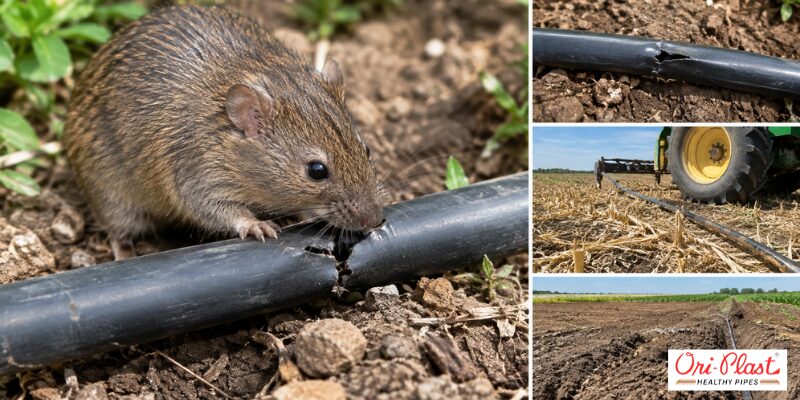
Exposed thin-walled tape and laterals can be cut by rodents or farm tools. Bury mains, protect laterals along headlands, and avoid dragging pipes over stubble—the storage and handling precautions outlined in proper storage and installation practices for farm piping cover this in more detail.
Ready to Buy? Where LLDPE, HDPE & PVC Fit Your Budget
If thinking "buy LLDPE drip irrigation pipe" or "buy PVC agriculture pipe for drip system," align purchase with role:
Laterals: Buy LLDPE inline or plain laterals in 16mm rolls (300m/500m) with 30–40 cm spacing.
Mains & submains: Buy HDPE coils for long, buried runs; buy PVC pipes and fittings for surface manifolds and valve stations.
Seasonal vegetables: Consider T‑tape for low upfront cost, planning replacement every 1–3 seasons.
Working with an LLDPE drip pipe manufacturer that also supplies HDPE and PVC ensures consistent quality across the entire network. Brands that offer agriculture drip pipe brands India with clear technical data, warranty, and local service reduce risk and downtime—worth comparing against Oriplast's LLDPE water tank range for farm storage when planning the full water chain.
Under PMKSY, small and marginal farmers can receive 55% central assistance (45% for others), with many states adding top-ups that push effective support to 80–90% in some regions. That makes investing in the right pipe mix not just agronomically smart, but financially sensible.
A Quick Field Story: From Guesswork to Confidence
Back in Raipur, the farmer swapped cracked laterals for UV-stabilized 16mm LLDPE with 40 cm spacing, fed by a 63mm HDPE main from the borewell and a PVC manifold near the plot. A disc filter was added and weekly flushing scheduled. Within one season, water bills dropped, the tomato canopy filled evenly, and the far end of the field no longer lagged. Neighbors in nearby villages started asking for the supplier's number—proof that the right pipe choice travels faster than gossip.
If this guide helped the field be seen through the lens of the right pipe, deeper dives on sizing mains, designing manifolds, and avoiding the top 10 installation mistakes will likely be appreciated. More practical, field-tested irrigation and plumbing blogs cover exactly that — stay tuned for more, one drop at a time.
FAQs: Types of Drip Irrigation Pipes in India
What are the main types of drip irrigation pipes in India?
LLDPE laterals, HDPE mains/submains, PVC mains/manifolds, and T‑Tape for seasonal crops.What is LLDPE drip irrigation pipe used for?
Primarily as 12–20mm lateral lines along crop rows with inline or punch-in drippers.What is HDPE pipe used for in drip irrigation?
High-pressure main and submain lines from borewell/pump to field, especially for long or buried runs.What is PVC pipe used for in drip systems?
Rigid main lines, manifolds, and fixed networks where cost and easy fittings matter.Which is better for the main line: PVC or HDPE?
Depends on layout: PVC for cost and surface manifolds; HDPE for long, buried, or high-surge lines.When should T‑Tape be chosen over LLDPE laterals?
For seasonal vegetables and tight budgets where tape can be replaced every 1–3 seasons.What size lateral pipe is best for vegetables?
16mm LLDPE with 30 cm dripper spacing is a common, balanced choice.How can clogging in drip pipes be prevented?
Use proper filtration (screen/disc/sand media), flush laterals regularly, and choose larger-flow-path emitters for silt-prone water.Why do some drip pipes crack in one season?
Lack of UV stabilization, poor-quality resin, and mechanical damage from farm operations.Is ISI certification necessary for drip pipes?
Not legally mandatory everywhere, but strongly recommended for quality and to qualify for subsidy schemes.Can the same pipe be used for main and lateral?
Technically possible but not ideal; mains need higher pressure rating and larger diameter than laterals.How long do LLDPE laterals last?
Typically 5–10 years with UV-stabilized grades and proper maintenance; less if exposed to harsh conditions.How long does T‑Tape last?
Usually 1–3 seasons depending on thickness, crop, and handling.What wall thickness should be chosen for LLDPE laterals?
0.6mm for light seasonal use; 0.8–1.0mm for multi-season orchards and rough handling.Are pressure-compensating laterals needed?
Yes, for long rows, sloping fields, or where uniform flow across the field is critical.