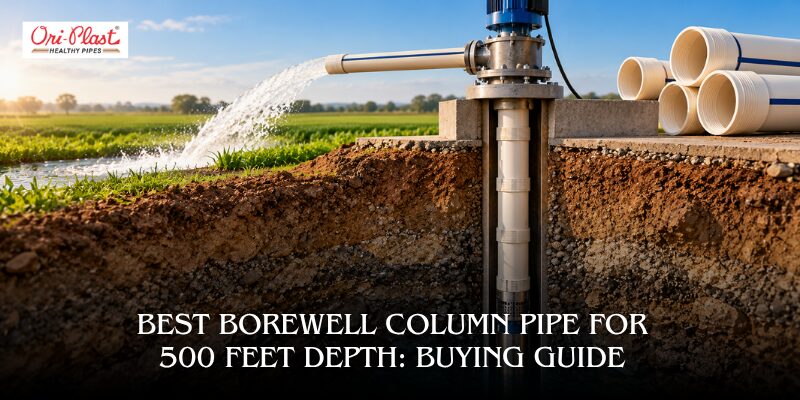
Mechanical Stress Factors at 500 Feet Depth
- Vertical tensile load capacity: Lower pipe sections and joints carry the combined suspended load of the pump, water, pipe stack, and cables. Confirm the pipe’s allowable load and joint strength for the complete installation.
- Bursting and hydrostatic pressure resistance: The pipe must withstand operating pressure and pressure surges, including water hammer. Select a rated product based on the pump’s operating conditions, not depth alone.
- Rotational torque absorption: Pump startup can transmit torque and vibration through the column. Properly designed, correctly assembled threaded joints help reduce the risk of joint damage or loosening.
Technical Comparison: Column Pipe Selection by Depth
Use this as a preliminary guide, not a substitute for the manufacturer’s pressure and load tables. Required ratings depend on pipe diameter, water level, pump, installation, and operating conditions.| Well depth | Recommended pipe class | Operating pressure rating | Thread geometry | Jointing mechanism | Corrosion resistance |
| Shallow well (<250 ft) | Class selected for pump and load | Verify product rating; no single rating suits every installation | Product-specific; trapezoidal where specified | Threaded socket or manufacturer-approved joint | uPVC resists rust; verify product suitability |
| Medium depth (250–450 ft) | Medium or heavy class, as confirmed by load calculations | Check the manufacturer’s pressure and tensile data | Reinforced thread design recommended | Manufacturer-approved threaded joint | uPVC does not rust like metal |
| Deep well (500–1,000+ ft) | Heavy-duty class, engineered for the installation | Confirm rating against system pressure and surge conditions; do not assume 15–25 bar is suitable for every system | Thickened trapezoidal threads where specified | Reinforced bell-type socket or approved joint | uPVC is corrosion-resistant; confirm service conditions |
Essential Features to Verify Before Purchasing
- Trapezoidal thread design: A broad thread profile can distribute load across a larger contact area than a narrow profile, but performance depends on the pipe design, material, and correct assembly.
- Thickened socket ends: Check that socket dimensions and joint performance are rated for the expected tensile and pressure loads.
- Water-contact material: Request documentation for the compound and its suitability for the intended water use. Do not assume a product is lead-free without manufacturer confirmation.
- Smooth internal surface: A smooth bore can help limit friction losses; compare hydraulic data for the selected diameter and flow rate.
- IS 12818 compliance: Verify that the specific product is marked and certified to the applicable standard, and check the certificate and current product documentation.
uPVC vs. Traditional Galvanized Iron Pipes
- Weight and handling: uPVC is generally lighter than metal pipe, which can simplify handling; the weight difference varies by product and size.
- Corrosion and scaling: uPVC does not rust, though suitability still depends on the water, soil, temperature, and installation conditions.
- Life-cycle value: Compare purchase price, pump energy requirements, installation costs, and expected maintenance over the intended service life. Avoid assuming a fixed electricity saving or service life without project-specific data.