
Why CPVC Is Best for Home Plumbing
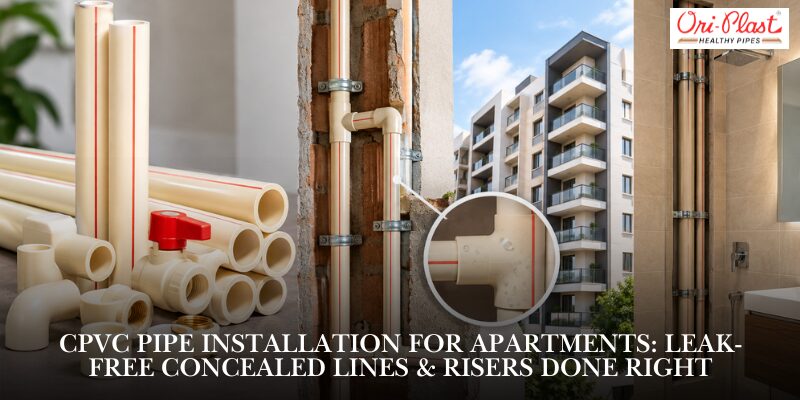
CPVC is specifically designed for both hot and cold potable water distribution, unlike ordinary uPVC, which is intended primarily for cold-water service. Ori-Plast CPVC pipes are available in sizes from 15 mm to 150 mm and are rated for temperatures up to 82°C.- Thermal tolerance: CPVC withstands continuous hot-water streams up to 82°C, with short-term exposure up to 93°C; standard uPVC is unsuitable for sustained hot-water service above about 60°C.
- Hygienic potable-water safety: Certified CPVC systems are made for drinking-water supply under IS 15778, with lead-free formulations that avoid rust, scale, and chemical contamination concerns associated with ageing metal pipes.
- Lower heat loss: CPVC has lower thermal conductivity than copper or GI, helping hot water remain hotter for longer and reducing energy loss between the geyser and outlet.
- No corrosion or scaling: The smooth internal bore resists calcium and magnesium deposits, helping maintain flow area, water pressure, and hydraulic efficiency over time.
- Leak-resistant jointing: CPVC uses solvent cement to create a chemically bonded, monolithic joint rather than relying on threaded mechanical connections.
CPVC vs. uPVC vs. GI Pipes
| Performance Metric | Ori-Plast CPVC Pipes | Standard uPVC Pipes | Galvanized Iron (GI) Pipes |
| Maximum operating temperature | Up to 82°C continuous; up to 93°C short-term | Up to 60°C, cold-water use only | Up to 90°C, but prone to scaling |
| Corrosion and rust risk | 100% immune | 100% immune | Very high; rust and discolouration |
| Jointing method | Cold solvent weld, chemical bond | Solvent weld | Threaded joints; higher leak risk |
| Service life expectancy | 50+ years, maintenance-free | 30–50 years | 10–15 years |
| Flow hydraulics | Smooth interior, no scaling | Smooth interior | High friction loss and scaling |
SDR 11 vs. SDR 13.5: Which CPVC Class to Choose?
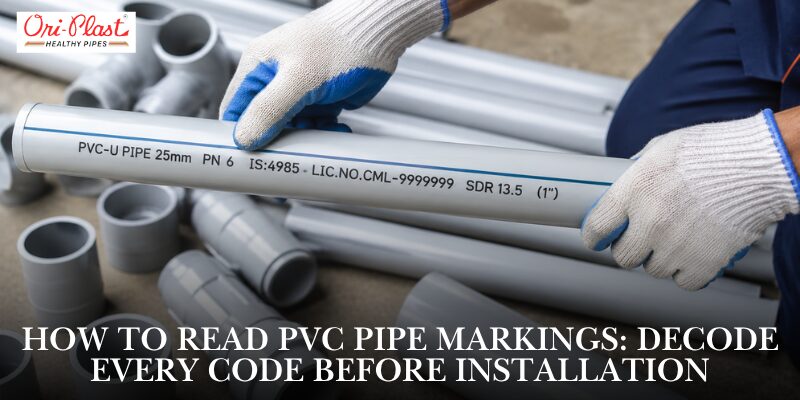
SDR means Standard Dimension Ratio: SDR=Outer DiameterWall Thickness SDR= Wall Thickness Outer Diameter A lower SDR number means a thicker wall and greater pressure resistance. Ori-Plast offers both Class I / SDR 11 and Class II / SDR 13.5 CPVC pipes, along with Schedule 40 and Schedule 80 options.| CPVC Class | Best Use Case | Why Choose It |
| SDR 11 / Class 1 | High-pressure lines, vertical risers, concealed bathroom walls, solar water-heater inlets | Thicker wall, higher pressure resistance |
| SDR 13.5 / Class 2 | Horizontal branch lines, cold-water loops, standard residential distribution | Economical choice for normal household lines |
| Schedule 40 / Schedule 80 | Larger residential or commercial connections | Specified under ASTM F441/F439 for higher-duty applications |
How to Ensure Leak-Free CPVC Jointing
Correct installation is as important as pipe quality. Use Ori-Plast Approved CPVC Solvent Cement and follow these steps for a durable, leak-free cold-welded joint.- Cut perpendicular to the axis: Use a pipe cutter or fine-tooth saw to make a clean, square cut, maximising socket contact area.
- Deburr and chamfer: Remove internal burrs and chamfer the outside edge at a 10–15° angle so insertion does not scrape away the solvent cement.
- Dry-fit first: Confirm that the pipe enters the fitting socket easily to about one-third to two-thirds depth before applying cement.
- Apply solvent cement: Apply a thin, even coat inside the socket and a generous coat on the pipe end using Ori-Plast CPVC Solvent Cement.
- Insert and quarter-turn: Push the pipe fully into the fitting until it bottoms out, rotate it a quarter-turn to distribute the cement, and hold firmly for 10–15 seconds.
- Allow proper curing: Wait at least 15–30 minutes before handling and 24 hours before pressure testing up to 10 kg/cm².
Why Choose Ori-Plast CPVC Pipes?
Ori-Plast CPVC systems are engineered as a complete residential plumbing solution rather than a pipe-only product. The company’s CPVC range includes pipes, fittings, valves, transition fittings, and solvent cement designed to work together.- Certified to IS 15778 and ASTM D2846: Ori-Plast CPVC products carry ISI marking for IS 15778 and conform to key ASTM standards.
- 100% virgin, lead-free compound: Supports safer drinking-water supply and hygienic potable-water distribution.
- High impact and UV resistance: Formulated for demanding site handling and ambient UV exposure during installation.
- Complete system compatibility: Pipes, brass-inserted transition fittings, valves, elbows, tees, reducers, unions, and solvent cements are available within the ecosystem.
- 50+ year fit-and-forget lifespan: Corrosion-free, low-maintenance performance makes CPVC a long-term infrastructure investment for homes.
- Wide size range: CPVC pipes are available from 15 mm to 150 mm, covering standard bathrooms through larger residential and commercial supply requirements.