Molecular Engineering: How PERT Achieves Heat Resistance Without Cross-Linking
PERT is a thermoplastic polyethylene material engineered to maintain useful mechanical strength at elevated temperatures. Its molecular structure provides a balance of flexibility, toughness, and long-term hydrostatic performance without requiring the cross-linking process used to manufacture PEX.1. Ethylene-Octene Side-Chain Branching
PERT grades commonly use carefully controlled molecular branching, often involving octene comonomers, to achieve their required mechanical and thermal properties.- Improved elevated-temperature performance: The polymer structure is engineered to retain strength under sustained hot-water conditions.
- Long-term hydrostatic strength: Appropriate material grades can withstand defined temperature and pressure combinations when used within their rated operating limits.
- Flexibility and toughness: The molecular design supports bending and installation in suitable plumbing configurations.
- Material consistency: Performance depends on the specific resin grade, pipe construction, dimensions, and manufacturing quality.
2. Recyclability and Material Recovery
PERT remains a thermoplastic after manufacture, so suitable clean material can be remelted and reprocessed under controlled conditions.- Thermoplastic processing: PERT can be softened and reshaped using appropriate processing equipment.
- Potential material recovery: Clean production scrap may be suitable for recycling, depending on grade and process controls.
- Reduced cross-linking constraints: Unlike cross-linked PEX, PERT does not have a permanent cross-linked network that prevents conventional remelting.
3. Thermal Fusion Jointing Capability
Compatible PERT pipe and fitting systems can use approved thermal fusion techniques to form a joint through controlled heating and joining.- Material bonding: Heat and pressure, applied according to the specified procedure, create a fused connection.
- Reduced dependence on mechanical seals: Compatible fusion joints do not require a separate O-ring at the fused interface.
- Consistent connections: Correct heating time, temperature, alignment, and cooling help achieve reliable joints.
- Installation quality: Incorrect fusion temperatures, contamination, or poor alignment can compromise joint integrity.
Technical Comparison Table: PERT Pipe vs. PEX Pipe
| Parameter | PERT Pipe | PEX Pipe |
| Molecular structure | Thermoplastic polyethylene with engineered molecular branching | Polyethylene with a cross-linked polymer network |
| Polymer type | PE-RT, with performance dependent on the specific material grade | PEX-a, PEX-b, or PEX-c, depending on the cross-linking process |
| Jointing technology | Compatible systems may use thermal fusion or approved mechanical fittings | Commonly uses expansion, crimp, clamp, or compatible mechanical fittings |
| Recyclability | Can be remelted and reprocessed under suitable conditions | Conventional remelting is not possible because of cross-linking; specialised recycling processes may be available |
| Continuous operating temperature | Product-specific; depends on pressure rating, material grade, and design life | Product-specific; depends on pressure rating, material grade, and design life |
| Peak operating temperature | Must follow the manufacturer's specified short-term and fault-condition limits | Must follow the manufacturer's specified short-term and fault-condition limits |
| Flexibility and coilability | Generally flexible; bending radius and low-temperature handling depend on grade and pipe dimensions | Generally flexible; handling and bending performance depend on grade, dimensions, and installation conditions |
| Oxygen barrier availability | Available in selected multilayer or barrier-equipped products | Available in selected oxygen-barrier products |
| Expected service lifespan | Determined by rated temperature-pressure conditions, design assumptions, installation, and maintenance | Determined by rated temperature-pressure conditions, design assumptions, installation, and maintenance |
| Typical applications | Hot and cold water distribution, heating systems, and other approved fluid applications | Hot and cold water distribution, radiant heating, and other approved fluid applications |
Joint Integrity: Thermal Fusion vs. Mechanical Fittings
The connection method is a major factor in the reliability of any hot water plumbing system. Both fused PERT connections and correctly installed PEX mechanical connections can provide dependable service when the components are compatible and used within their specified operating limits.1. PERT Thermal Fusion Joints
Where the selected PERT product is approved for socket fusion, the pipe and fitting are heated under controlled conditions and joined to create a fused interface.- Integrated connection: The fused interface bonds compatible thermoplastic surfaces without relying on a separate sealing ring at that interface.
- Fewer interface-specific sealing components: The fused connection does not depend on an O-ring between the pipe and fitting.
- Consistent jointing process: Using the specified equipment and procedure helps produce repeatable results.
- Installation discipline: Heating temperature, insertion depth, alignment, and cooling time must follow the manufacturer's instructions.
2. PEX Mechanical Fittings
PEX plumbing systems commonly use expansion fittings, crimp rings, clamp rings, or other approved mechanical connection technologies.- Mechanical retention: The fitting and connection mechanism hold the tubing securely in place.
- System-specific components: Fittings and tubing must be compatible with the selected connection system.
- Seal design: Some connections rely on elastomeric seals, while others use different sealing arrangements.
- Installation control: Correct tools, fittings, tubing preparation, and connection verification are essential.
3. Which Jointing Method Should You Choose?
Consider these factors before specifying a system:- Installation environment: Determine whether fusion equipment can be used conveniently and safely.
- Installer expertise: Confirm that installers are trained in the chosen joining procedure.
- Maintenance access: Consider how connections will be inspected or serviced if required.
- Material compatibility: Use only fittings and joining methods approved for the selected pipe.
- Project economics: Compare equipment, labour, fittings, installation time, and expected maintenance requirements.
Primary Applications Suited for PERT Piping Systems
PERT pipes can be suitable for several hot and cold water applications, provided the product is specifically rated and approved for the intended service.1. Underfloor Radiant Heating and Cooling
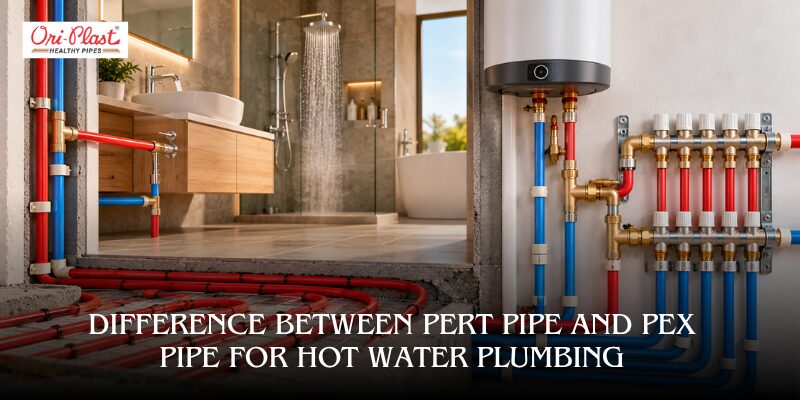
PERT pipes can be used in suitable hydronic heating systems to distribute heated water through floor circuits. Certain system designs also use water-based cooling, provided condensation and dew-point control are properly addressed.- Flexible routing: Flexible pipe can help installers lay continuous circuits with fewer intermediate connections.
- Circuit planning: Correct loop lengths, hydraulic balancing, and manifold selection are important.
- Thermal performance: Pipe selection must account for operating temperatures, pressure, and the heating system's design life.
- Oxygen diffusion: For closed-loop systems containing metal components, verify whether an oxygen barrier is required.
2. Solar Water Heating Systems
Solar thermal systems can experience high water temperatures, particularly during periods of low demand or stagnation. PERT may be appropriate for sections of a solar hot-water system when the specific product is rated for the actual operating and fault conditions.- Temperature verification: Check the maximum continuous temperature and permitted short-term temperature excursions.
- Pressure requirements: Confirm compatibility with the system's operating pressure and safety devices.
- Stagnation protection: Design the system to manage potentially extreme temperatures during stagnation.
- Manufacturer approval: Do not assume a PERT pipe rated for ordinary domestic hot water is automatically suitable for direct connection to a solar collector.
3. Domestic Hot and Cold Water Distribution
PERT can be used in approved domestic plumbing systems for supplying hot and cold water to kitchens, bathrooms, and other fixtures. Key selection criteria include:- Potable-water suitability: Verify the product's certification or conformity documentation for drinking-water contact.
- Temperature and pressure rating: Select the correct pipe class for the system's operating conditions.
- Joint compatibility: Use approved fittings and installation procedures.
- Water quality: Confirm that the pipe and fitting materials comply with the applicable requirements for the intended water supply.
4. Industrial Fluid Transport
Certain PERT piping products can be used for selected industrial fluid applications when their chemical compatibility and operating ratings are suitable.- Chemical compatibility: Evaluate the fluid composition, concentration, and temperature.
- Pressure performance: Confirm the allowable pressure for the actual operating temperature.
- Stress-cracking resistance: Review material-grade data and the system's design conditions.
- Application approval: Use the pipe only for fluids and environments permitted by the manufacturer.
Why Choose Ori-Plast PERT Pipes & Fittings?
Ori-Plast Limited has a manufacturing history dating back to 1965 and offers piping products for a range of building and infrastructure applications. Its PERT Pipes & Fittings range is worth evaluating for projects that require hot and cold water distribution solutions.1. Product-Specific Material Quality
The quality of a PERT piping system depends on its resin grade, dimensional consistency, manufacturing controls, and documented performance. Before specifying Ori-Plast PERT pipes, request current technical datasheets covering material classification, applicable standards, temperature-pressure ratings, and conformity documentation. Where the product documentation confirms the use of high-grade imported raw materials, this information can support procurement evaluation alongside the finished product's verified performance.2. Flexibility and Installation Planning
Flexible piping can simplify routing around building services and reduce the number of fittings needed in suitable layouts. Potential installation benefits include:- Simplified routing: Flexible sections can accommodate approved bends without requiring an elbow at every change of direction.
- Reduced cutting waste: Careful layout planning can help optimise pipe lengths and material usage.
- Fewer intermediate connections: Appropriate continuous runs can reduce the number of joints.
- Practical installation: The actual benefit depends on the specified bending radius, access, pipe diameter, and installer experience.
3. Matching Fittings and Transition Adapters
A compatible fittings range helps contractors design connections between PERT piping, manifolds, valves, and other plumbing components. Depending on the available product range, check for:- PERT-compatible fusion fittings.
- Approved threaded transition adapters.
- Connections to fixtures and distribution manifolds.
- Accessories specified for the selected pipe series.